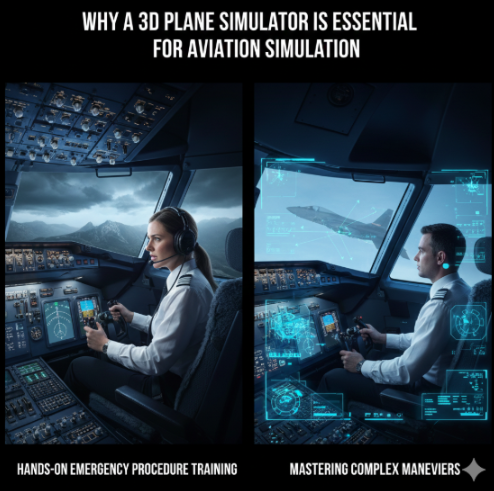
Aviation is regarded as one of the most complex, safety-critical industries in the world. Pilots are required to know all the aircraft systems and controls, as well as decision-making skills, system operation, navigation, emergency procedures, etc. Experience in a real aircraft can be dangerous, costly, and difficult, which is why a 3D plane simulator offers a fundamental platform for any current aviation simulation.
More than a mere visual tool, a 3D plane simulator provides a safe, consistent, realistic environment for pilots to learn, practice, and improve their skills without jeopardizing safety or operational costs.
Providing Flight Experiences With No Risk
A fundamental reason aviation simulation involves 3D simulators is safety; separate sides of the spectrum can‘t be practiced in actual aircraft.
Conditions such as engine system failures, abnormal weather, runaway automation, or emergency landings are untouchable in real life without huge risks.
A 3D plane simulator can simulate these at extremely high fidelity while removing the risk completely. Pilots can experience critical situations, make errors, and refine their responses without the hazards of real airports and aircraft.
Precision in Simulating Aircraft Controls and Systems
Aircraft simulation and operational accuracy extend to every part of a 3D plane simulator. The central object is an accurate airplane model, one that incorporates aerodynamics, cockpit layout, landing gear, and other flight control elements and reactions.
Combining this with correct environmental factors such as weather, navigation, and system malfunctions allows pilots to simulate:
- Flight characteristics of normal and abnormal circumstances
- Instrument flying
- Navigation scenarios
- Flight control management
Crucially, this sort of time-consuming, complex knowledge is gained hands-on, rather than by book learning.
Developing Situational Awareness Skills
Situational awareness sits at the core of safe flying. A pilot needs to be constantly aware of their aircraft, traffic, weather, and system status.
With a 3D simulator, pilots can familiarize themselves with terrain, airspace, runways, other vehicles, and safety obstacles in a visual environment. Students’ skills are honed in interpretation, workload management, and the ability to control within high stress, similar to real flying.
This improves safety for all pilots and airline personnel involved.
Promoting Repetition and Efficient Skill Development
Repetitive hand practice speeds up flying skill development and mastery.
Unfortunately, this is constrained by usable aircraft hours, pilot workload, and high operating costs.
A 3D plane simulator enables pilots to repeatedly practice all the maneuvers they require in an environment independently of costs, ground crew availability, and weather constraints.
By breaking down training into manageable modules and customizing training to each specific pilot‘s performance, skill acquisition is rapid.
Assisting Decision-Making in Flight
Pilot decision-making skills are essential for high levels of flight safety.
Simulated flights enable piloting through scenarios in which weather, traffic, or some other circumstance is continually changed to test the pilot‘s perceptiveness, prioritization ability, and response time.
Having this experience instills confidence and ensures faster reactions in unpredictable emergency situations.
Supporting Standardized, Objective Learning
One problem with real-world training is ‘learning variance’, where variations in circumstance may unevenly favor one student over another.
A 3D plane simulator can standardize training situations for new pilots, to guarantee comparable exams. The sensor and decision data obtained with simulators can be objectively monitored by instructors.
Minimized Costs with Maximized Return on Investment
Real flying involves fuel, airworthiness, and general maintenance, insurance, and individual operating and hire costs, which are expensive.
Simulators greatly mitigate these, particularly for initial learning, leading to significant savings for the aviation industry.
Simulators also make pilot training more accessible, efficient, and flexible, increasing available pilot hours without the excess costs of a real aircraft.
Connecting Theory to Practice with High Precision
Theoretical learning won‘t become second nature until practiced.
A 3D plane simulator is the bridge that turns aviation theory into practical knowledge and enables quicker, more satisfying learning experiences for pilots.
Simulating knowledge such as aerodynamics, weather, and navigation enables perfect understanding from the word go, saving many hours of theory study.
Training in the nuances of crosswinds, crashes, or instrument flying results in more confident, prepped aeronauts.
Supporting Advanced and Specialized Aviation Training
The same simulation principles that apply to basic flying can be leveraged for more complex or specific training, including:
- Specific aircraft type endorsement
- crew resource management
- advanced autopilot monitoring
- Emergency and abnormal procedure drills
As these requirements exist for increasingly unique users, digital modeling makes this more practical and easier.
Preparing for the Modern (and Future) Aviation Fleet
Today‘s aircraft include greater electronics and automation, digitally controlled systems and commercial grade Wi-Fi. To keep trainees relevant, training must incorporate these features.
A 3D plane simulator can ensure each modern pilot is familiar with the cockpit environment they will go into, giving graduates more accurate muscle memory.
High-quality 3D Creation is the Key
The fidelity of a 3D plane simulator is absolutely reliant on the quality, accuracy, and optimization of the digital components.
An inadequate level of detail and accuracy will produce poorly simulated, vice-like results.
This is where experienced 3D modeling services, with their comprehensive understanding of aircraft specifications and 3D design experience, become integral. Well-modeled airplanes and high-performance for entire simulators deliver a consistent experience, building trust and increasing the transferability of skills.
Conclusion
While once a supplementary pre-flight simulator training venture, today‘s standard, highly detailed 3D plane simulator has established itself as an essential tool in aviation. It provides a safe, reliable, accurate source for pilot training, accelerating and deepening human competence, as well as changing the way pilots learn and improve.
Cost, safety, the range of training scenarios, the consistency of elite experiences, and the increasing sophistication of aircraft ensure that 3D plane simulators will become more and more prevalent in all areas of flight simulation. High-quality 3D assets are assured to underpin this phenomenon, bringing the most realism, precision, and transferability to aviation education.