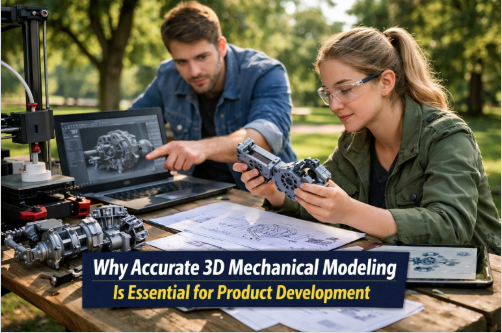
Product development has become faster, more competitive, and more complex than ever before. It is also expected that companies should be able to provide high-performing and reliable products while reducing costs and time to market. This is why 3D mechanical modeling has become an integral part of product development.
Accuracy as the Foundation of Successful Design
Each product starts with an idea, but the process of taking that idea and turning it into a manufacturable reality is a very precise process. There are sizes, tolerances, clearances, and mechanical relationships that have to be defined correctly right from the very beginning. Incorrectly defined parameters can lead to a whole series of problems down the road.
This enables engineers to check their hypotheses at an early stage. With accurate geometry and measurements, engineers can proceed with the project, knowing that the design represents real-world constraints and requirements rather than approximations.
Reducing Design Errors Early in Development
One of the major benefits of digital modeling is the ability to spot errors before prototypes are made. Components that are not properly aligned, interference problems, and tolerance problems can all be detected at the design stage.
This is because the early identification of these problems in a project will ensure that costly changes are avoided in the later stages of the project when tooling may have already been developed or production lines set up. Early error detection will not only save money but also ensure that project timelines and morale are protected.
Improving Collaboration Between Teams
Product development is a process that usually involves several different departments, such as engineering, manufacturing, quality assurance, and purchasing, and sometimes even contract vendors. A good model can be a common reference point for all of these different parties.
When the whole team is working on the same model, there are fewer chances of misunderstandings. The manufacturing teams can analyze the feasibility, the quality teams can determine the inspection criteria, and the procurement teams can plan their procurement accordingly.
Supporting Reliable Prototyping and Testing
Prototypes are very important in the verification of form, fit, and function, but they are also very costly and time-consuming. Digital models help ensure that prototypes are made right the first time.
With the right models, simulation software can be employed to test the strength, dynamics, thermal properties, and ruggedness before the actual testing process is initiated. This will enable fewer prototype stages and physical testing to concentrate on final verification rather than addressing fundamental design issues.
Managing Complexity in Modern Products
Contemporary products involve complex assemblies with multiple interacting components. The more complex the product, the higher the opportunities for errors. Digital modeling assists in this complexity by correctly defining the interaction of components in assemblies.
Enabling Faster Iteration and Innovation
The advantage of speed is in product development. With accurate models, it is faster to iterate because one can make changes without worrying about creating other problems in the design.
When engineers believe in the accuracy of their models, they can then think about alternatives, optimize, and innovate. This is because engineers can then work easily.
Cost Control and Risk Reduction
The issues that are pointed out towards the end of the development process are more expensive to correct compared to those that are identified earlier. Modeling helps in risk mitigation by ensuring that there are fewer chances of design errors making it to the production floor.
In addition, digital accuracy also helps in cost control as it reduces rework, scrap, and delays. These factors help directly in cost control because of the cost savings that can be realized through digital accuracy, particularly when products are manufactured on a mass scale.
Supporting Long-Term Product Lifecycle Management
Trustworthy models are very useful even after the product has been placed in production. They can be used for maintenance, product updates, and redesigns. If problems arise in the real world, trustworthy models are very useful in troubleshooting.
Product lifecycle management requires data accuracy. The model that best represents the end product is the source of truth during the product lifecycle.
Scaling Development with External Expertise
If the product line is expanded, there could be resource constraints for the internal team. At times, a company may decide to outsource to a 3D game art outsourcing studio, especially when visualization or complex mechanical parts are involved.
Although these studios have traditionally been known to be a part of the entertainment industry, they can also bring a lot of modeling rigor, detail, and scalable processes that can support engineering teams working under tight deadlines. Collaboration, when done correctly, can add capacity without compromising accuracy.
Establishing Confidence in Final Products
Ultimately, accurate modeling means confidence—confidence in design decisions, confidence in manufacturing readiness, and confidence in product performance. The teams that are utilizing accurate digital models are better equipped to meet market and regulatory needs.
The choice to invest in the accuracy of 3D mechanical modeling is more than a technical choice; it is a strategic choice with implications for quality, speed, and success.
Conclusion
Accuracy is the key to successful product development. The role of 3D mechanical modeling in this regard cannot be overstated. This is an important step that helps in accuracy in design, error detection, testing, and easy transition to production. Accuracy in mechanical modeling, whether it is related to risk reduction and cost management or cooperation and life cycle management, is the key to all aspects of product development. Whether it is done in-house or with the help of a good 3D game art outsourcing firm, accuracy in mechanical modeling is the key to the development of quality products in the current competitive market.